Small Living World
Designing Zoos, Bioparks and Terraria
A park with animals is a small living world that does not close at night. When you save in the wrong place, the animal pays.
Coming soon · Polish edition available to orderOrder the Polish Edition Discuss a Project
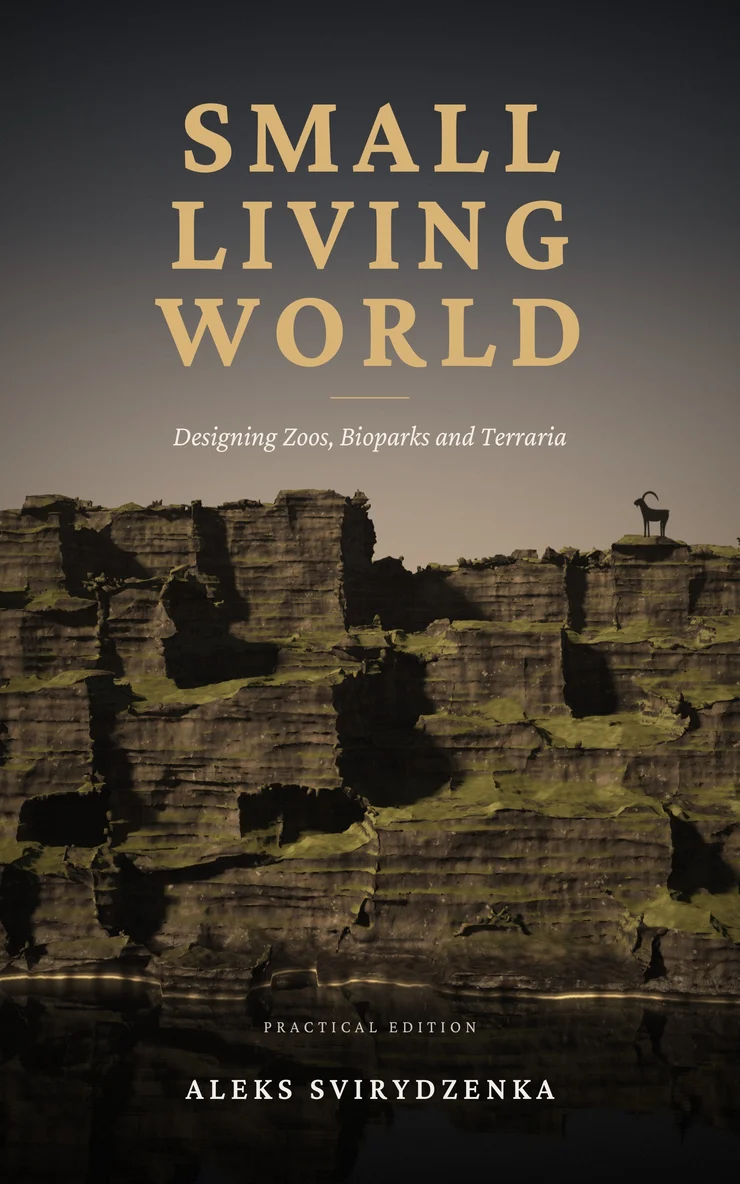
Between the science and the concrete
Welfare science knows a great deal about what animals need. Builders rarely read it. Species requirements sit in documents of different countries and different legal force. And on the craft itself — rock, surface and coating in an animal's environment — there is very little data.
This book stands exactly in that gap. It shows how to turn what science knows about an animal's life into real decisions: the brief, the budget, the barrier, the ground, the water and the surface of the rock the animal lives on every day — with decor and biotope that are true for the animal and convincing for people.
It is not a veterinary manual and not a structural calculation. It is a translation between disciplines — so that the knowledge of the vet, the zoologist and the engineer reaches the hands that finally build the animal's world.
A theme park is built for those who come. A zoo is built for those who stay.Small Living World
Not against anyone. For everyone who decides.
Zoo directors
The decisions that must be taken before construction — and the lines in a budget that must never be cut, because the animal pays for them.
Curators and keepers
A way to turn welfare needs into a brief that designers and contractors can actually build and price.
Architects and landscape designers
Barrier, ground, water, shelter and rock surface — decor and biotope as working parts of the habitat.
Contractors and craftsmen
What paws, hooves, claws and skin need from a surface, a coating and a detail — and how to check it on site.
Municipalities and procurement
Why price-only tenders become expensive, and what to ask designers and contractors instead.
Terrarium and aquarium builders
Closed, wet and warm worlds: terraria, pools and tropical halls, with their own risks.
Six sentences that carry the book
The public gives the first grade. Time gives the second.
An object is judged on opening day with the eyes — and years later by rain, frost, cleaning and use.
Truth for the animal. Conviction for the human.
Decor must convince the visitor; the biotope must serve the resident. Both, not one instead of the other.
Visitors see the beauty of the rock. The animal feels the truth of its surface.
Texture, grip, temperature and wear decide daily life in the enclosure.
Stone must convince people. It must serve the animal.
Two jobs for one surface — and why the second one cannot be traded away.
A good question before the first sketch costs less than any answer after the animals move in.
That is why every chapter ends with questions to ask.
Fair is when the one who earns pays — not the one who lives here.
The book's closing thought about who carries the cost of cheapness.
Evidence is labelled honestly throughout: what a study shows, what an organisation recommends, what a norm requires — and what is the author's own conclusion, open to dispute.
Eleven chapters and an afterword
Each chapter follows the same pattern: the argument and the evidence, short boxes from practice and from the workshop, and a closing set of questions in the form “Not: … Instead: …” — ready to take into a design meeting.
1A world that does not close at nightA small living world — and an obligation. Who pays for cheapness.
- Two parks after closing
- A good life, not only the absence of suffering
- Three users, one first client
- Who pays for cheapness: an evidence map
- From menagerie to biopark
2The main resident: the animalFrom “freedom from” to “a life worth living”.
- The Five Domains, read with a drawing in hand
- Choice and control
- Space, complexity and the trodden path
- Shelter, view, sound, light and sleep
- Group, keeper and old age
3The person at the enclosureFive seconds at the glass: the visitor as the third client.
- What stops a person
- Visibility is the first filter
- The attention budget
- How the environment changes the view of the animal
4Masterplan, site, seasons and standardsBiomes, not continents — and back of house first.
- The crane that could not get through
- Neighbours, and fewer species
- The site is alive
- A world for every season
5The boundary: barriers and safetyA wall in a rock costume — and the rock at the fence as the first way out.
- Moats: a beach, not a canal
- Glass, mesh and hot wire
- People on both sides
- Checklist and questions to ask
6Truth for the animal, conviction for the humanTwo exams for one rock.
- Why convince people at all
- How much truth is enough
- The double test
- The field reference
- Model, maquette and sample panel
- Geology for the sculptor
7The rock shell and its surfaceThree sides of one rock: inside, under paw, hoof and flipper, warm and cold.
- What hides inside the rock
- The surface under paw, hoof and flipper
- Warm and cold stone
- What disappears when the line is cut
8Functional decor, trees, ground, water and plantsDecor that is used, not only looked at.
- Feeders, hides and magnets
- Trees, vines, logs and termite mounds
- Ground is part of the decor
- Water in decor: basin first, then rock
- Living plants on artificial rock
9Colour, ageing, dioramas, unity of the zone — and does it work?Colour as geological biography — and the evidence.
- What to learn from the diorama
- Unity of the zone: theming without Disneyfication
- Does it work? What is proven and what is not
- A short gallery of benchmarks
10Terrarium, pool and tropical hallClosed, wet and warm worlds.
- The terrarium is a set of gradients
- Materials that do not kill
- The pool is a machine and a window
- The tropical hall: climate under a roof
11Project, money, construction and life after openingThe price of cheapness — and life after the ribbon is cut.
- The circle of a project
- Money and tender
- Building among animals
- Specification and acceptance
- Life after opening
✦Afterword: Who paysHow the animal pays — and what is proven versus the author's conclusion.
- The same scene
- How the animal pays
- What is proven and what is my conclusion
- Why the animal
- Morning
I am not trying to replace the vet, the zoologist or the engineer. I am trying to make sure their knowledge reaches the people who build the animal's physical world.Aleks Svirydzenka
Two editions of one book
The book is fully written and ISBN numbers are assigned. Because there is so much information, it comes in two versions: a short practical edition and the full edition in three volumes.
Short practical edition
The thesis, key evidence, decisions before construction and the questions to ask. Coming soon on Amazon.
Full edition in three volumes
The complete evidence base, species tables, case studies and bibliography. Coming soon on Amazon and other platforms.
Polish edition «Mały żywy świat»
The first edition appears in Polish. Order directly from the author.
The Truth About Artificial Rockwork
Not a book about fake rock, but about the distance between how things look and what they really are. Second, revised and expanded edition.
Discover the book →
Building Worlds
A step-by-step professional textbook for universities, architects, designers and creators of immersive environments — from concept to final result.
Discover the book →